What Should Lawn Mower Battery Voltage Be? A Practical Guide
Discover the ideal voltage for push and cordless lawn mowers, how voltage relates to capacity, how to measure safely, and practical tips to maintain peak performance.


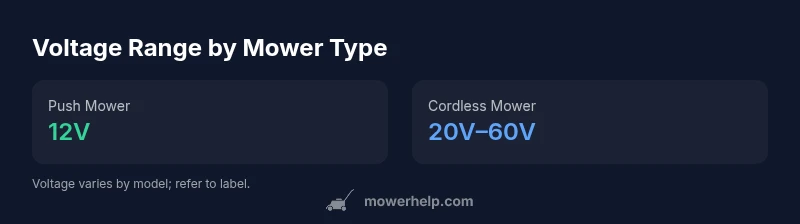
The standard voltage you should aim for depends on your mower type. Most push mowers use a 12-volt battery, commonly lead-acid or AGM, while cordless models use higher voltage packs in the 20–60 volt range. Always verify the exact voltage printed on your model's label. Consult your manual for the recommended voltage and consider voltage tolerance.
Understanding Voltage Basics for Lawn Mower Batteries
Voltage is the electrical pressure that pushes electrons through the circuit. For lawn mowers, the voltage rating usually corresponds to the battery pack, and it defines compatibility with the mower's power system. In practice, the voltage you see on the label guides both replacement choices and safety practices. For most traditional push mowers, you’ll encounter a 12-volt battery. In cordless models, the voltage is higher, reflecting the power demands of modern cutting decks and longer run times. It is essential to differentiate voltage from capacity (Ah). A battery can deliver a certain voltage but vary widely in how long that power lasts, depending on its capacity. When diagnosing performance issues, voltage is a quick diagnostic, but never the sole indicator of battery health. A voltage reading should be taken under the same state of charge when possible, preferably with no-load and then under load to understand how the system behaves during actual mowing. If you’re wondering what should lawn mower battery voltage be for your machine, the answer hinges on whether you’re using a push mower or a cordless model.
Common Battery Types and Their Voltage Ranges
Most older and current push mowers use lead-acid or AGM 12V batteries. These are reliable and cost-effective, and they tolerate a wider range of environmental conditions. Cordless electric mowers employ higher voltage packs, usually in the 20V–60V range, with 40V and 56V being particularly common choices among mainstream brands. Lithium-ion packs offer lighter weight and better energy density but require electronic management systems. Regardless of chemistry, the voltage must match the mower’s designed input; using a battery with too low voltage can cause cranking failure, while a higher voltage pack may strain the motor and control circuitry if the system isn’t rated for it. Always check the manual or the sticker on the battery or battery compartment to confirm the exact voltage requirement and any allowable tolerance.
How to Check and Troubleshoot Battery Voltage
Start by safety: turn off the mower, remove the key or unplug the tool, and let the battery rest for a few minutes if it’s been under heavy use. Use a digital multimeter and measure terminal voltage with the mower disconnected from any charging source. A fully charged 12V lead-acid battery typically reads around 12.6V to 12.7V on a fresh charge; reading around 12.0V indicates a discharged state. For cordless packs, use the charger’s built-in indicators or the pack’s own readout when available. If your voltage readings are inconsistent or drop sharply under the load test, the battery may be failing, the connections could be corroded, or the pack’s internal cells may be imbalanced. Replace or service according to the manufacturer’s guidance. Regular maintenance, including cleaning terminals and ensuring proper seating, can prevent voltage drop caused by simple poor connections.
Cordless Mowers: Voltage, Capacity and Run Time
Voltage is just one piece of the puzzle. Run time is primarily a function of capacity (measured in amp-hours, Ah) and how aggressively you mow. Two packs with the same voltage can have very different runtimes if one offers more Ah. For example, a 40V pack with 2.0 Ah will behave differently from a 40V pack with 5.0 Ah, even though the voltage matches. Temperature, age, and discharge rate also affect performance; older packs may show reduced voltage under load. When selecting replacements, don’t assume all 40V batteries are interchangeable. Check the voltage, the chemistry, the cell configuration, and the form factor to ensure compatibility with your mower model. If in doubt, reach out to the manufacturer or a trusted service provider.
Choosing the Right Voltage: Step-By-Step
- Locate the model’s voltage specification on the mower label or user manual; 2) Verify the battery you already own or plan to buy matches the specified voltage; 3) Confirm the chemical compatibility (lead-acid, AGM, lithium), as this affects charging and safety; 4) Check the empty-run and fully charged voltages you should expect from your battery type to calibrate expectations; 5) When possible, measure both no-load and loaded voltage to gauge health; 6) If replacing, prefer OEM or official third-party units that specify voltage tolerance. These steps reduce the risk of damaging electronics and ensure consistent performance.
Voltage by mower type and battery chemistry
| Model Type | Typical Voltage Range | Battery Type | Notes |
|---|---|---|---|
| Push Mower (Traditional) | 12V | Lead-acid/AGM | Reliable and affordable |
| Cordless Mower | 20V–60V | Lithium-ion pack | Higher power, variable runtimes |
| Riding Mower (Cordless) | 36V–56V | Lithium-ion | Higher power needs |
| Convertible cordless | 48V–72V | Lithium-ion | High-end models |
Got Questions?
What is the standard voltage for most lawn mower batteries?
Most push mowers use a 12V battery (lead-acid or AGM). Cordless models use higher voltage packs, typically in the 20V–60V range, depending on the brand.
Most push mowers use 12V, while cordless mowers use higher voltage packs, usually 20V to 60V.
How can I check my lawn mower's battery voltage safely?
Turn off the mower, remove any power source, and use a digital multimeter to measure terminal voltage. Compare it to the label’s specification and expected no-load voltage.
Turn off the mower, then use a multimeter to measure the battery voltage at the terminals.
Is it safe to replace a 12V battery with a higher voltage pack?
No. Replacing with a higher voltage pack can damage electronics and safety systems unless the mower is explicitly designed for it.
No—don’t upgrade to a higher voltage unless the mower model specifically supports it.
What happens if voltage is low but capacity is still good?
Low voltage indicates insufficient power for starting or running the motor. Capacity affects runtime, but voltage must meet the required level for operation.
Low voltage means weak performance; you may get poor starting or stalling even with decent capacity.
Does voltage affect run time?
Voltage influences power delivery, but run time mostly depends on battery capacity (Ah). The same voltage with higher Ah will usually run longer.
Voltage matters, but capacity is the bigger factor for run time.
“Voltage is a critical piece of the puzzle, but it must be aligned with proper battery chemistry and capacity to ensure reliable performance and safety.”
The Essentials
- Verify the exact voltage on the mower label.
- Use manufacturer-specified voltage to avoid damage.
- Match voltage with compatible battery chemistry.
- Measure voltage to assess health and readiness.