Can You Use a Lawn Mower Engine in a Go-Kart? A DIY Guide
Explore whether a lawn mower engine can power a go-kart, understand compatibility, safety, mounting, and maintenance. Learn from Mower Help with a practical, step-by-step approach to a safe build.


Yes, you can repurpose a lawn mower engine to power a home-built go-kart, but it’s not a plug‑and‑play swap. Expect to wrestle with mounting geometry, throttle linkage, cooling, exhaust, and safety controls. This guide covers compatibility, core steps, and key cautions from Mower Help so you can build a safe, functional go-kart.
Why this path makes sense for DIYers (and where it fails)\n\nRepurposing a lawn mower engine for a go-kart can be an affordable, educational project that leverages a familiar powertrain. The same gas engine concepts you’ve used on a mower translate to a compact kart frame with some important caveats. The key trade‑offs are reliability, cooling under load, vibration, and the need for rigorous safety systems. According to Mower Help, thoughtful planning and strict adherence to safe practices make DIY conversions more likely to succeed. This section helps you decide if the project fits your goals, skills, and workshop constraints. If you love hands-on problem solving, a mower-based build can teach you about mechanical interfaces, fuel systems, and safety interlocks in a practical, observable way.
Compatibility basics: engine sizing, RPM range, and torque behavior\n\nA lawn mower engine carries familiar design language for speed control, cooling, and lubrication, but the way you use it on a go-kart differs from a mower. The first step is to understand how engine displacement, horsepower class, and the governor behavior influence acceleration and top speed on a kart frame. You’ll need sufficient cooling air, an exhaust path that won’t overheat or ignite nearby components, and a throttle linkage that reliably responds to your inputs. The guiding question is: does the engine provide enough torque at the kart’s expected weight and gearing without running at unsafe RPMs? The answer will depend on your frame weight, tire grip, and drive gearing. Can you use a lawn mower engine go kart? It’s possible with careful matching of engine characteristics to frame design and gearing.
Engine types and their quirks: mower motors vs kart powerplants\n\nNot all garden engines are created equal for go-kart use. Lawn mower engines are designed for steady-state operation and durability under continuous running at lower RPMs, not for sudden bursts of acceleration or high-load climbs. In a kart, the engine must tolerate rapid throttle changes, higher vibration, and narrower cooling margins. A common approach is selecting a mid-range displacement engine with a reliable cooling system and a simple air intake. You’ll also want to verify that the carburetion and ignition system tolerate the living conditions of a moving chassis rather than a flat lawn. The bottom line is that mower engines can work, but you should expect and plan for adjustments to fuel delivery, ignition timing, and exhaust routing.
Safety-first mindset: rules, PPE, and risk assessment\n\nModifying powertrain equipment for a go-kart involves real risk if safety is neglected. Always start with a defined safety plan: a dedicated testing area, a kill switch that shuts power instantly, a secure seat and restraints, guards on moving parts, and a fire suppression option within reach. Local and state regulations may impose restrictions on homemade vehicles, including registration, license, or inspection requirements. Document every modification, avoid mounting points near fuel lines or hot surfaces, and ensure all fasteners are double‑checked after the first test runs. The Mower Help team emphasizes safety as the foundation of a successful build, not an afterthought.
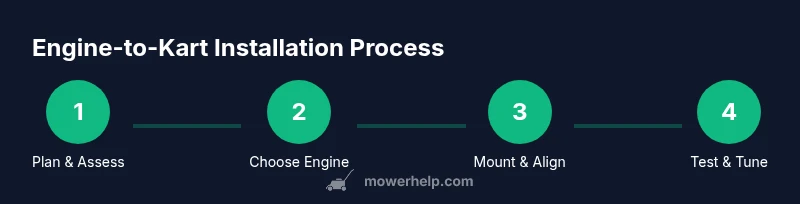
Planning your build: goals, budget, and risk assessment\n\nBefore touching metal, outline your goals: desired top speed, acceleration, and reliability. Establish a budget that includes a spare engine, mounting hardware, drive components, and safety gear. Perform a risk assessment that accounts for frame integrity, vibration, fuel safety, and operator protection. A well-scoped plan reduces improvisation during the build and helps you avoid unsafe shortcuts that could lead to accidents or damage. Remember to reserve space for testing and incremental improvements, rather than attempting a full‑tilt single‑run at the outset.
Engine selection and sourcing: what to look for (without a SKU)\n\nChoose an engine that balances weight, cooling, and fuel delivery for a kart frame. Look for a unit with consistent compression, accessible service parts, and a durable exhaust path. Favor engines with an integrated shutdown switch and simple throttle linkage compatibility. When sourcing, compare multiple condition levels (new/used) and assess available parts for tuneability and maintenance. Keep expectations realistic—your goal is a rebuildable, reliable powerplant that won't overheat in a small chassis.
Mounting and alignment essentials: frame, mounting points, and vibration control\n\nThe most challenging part is aligning the engine shaft with the kart’s drive system. You’ll need solid mounting brackets, shims to adjust lateral and vertical alignment, and vibration isolation to prevent frame fatigue. Ensure there’s adequate clearance for the pull start, exhaust, and fuel lines. Use locked fasteners and thread-locking compounds where appropriate. A poor alignment will cause belt or chain wear, poor power transfer, and safety hazards. Take time to mock‑up the engine with the frame before drilling or welding permanent mounts.
Throttle linkage, clutch, and drive system integration: getting power to the wheels\n\nLinking throttle to a lawn mower engine on a kart requires a reliable mechanical or cable-based linkage that returns to idle safely. If your engine uses a centrifugal clutch or a belt/chain drive, you’ll need compatible pulleys, a tensioner, and a method to prevent wheel spin during engagement. Ensure all moving parts are shielded, and that the kill switch can disable the engine instantly in an emergency. Maintain a consistent cooling airflow around the engine to prevent heat buildup.
Fuel, exhaust, cooling, and air intake considerations: keeping the engine safe and efficient\n\nRouting fuel lines away from hot surfaces and ignition sources is essential. The exhaust should be properly muffled and directed away from the driver, with a heat shield if necessary. Efficient cooling is crucial on a kart, which can accumulate heat quickly due to wind resistance and close frame spaces. Position the air intake to avoid water ingestion and debris while allowing enough airflow. Consider a simple shroud to improve cooling at low speeds and during static testing.
Testing, tuning, and maintenance plan: progressive validation and care\n\nBegin with low-speed tests on an open, obstacle-free area. Check for abnormal vibration, noises, or smoke, and stop immediately if something unusual occurs. Document measurements such as idle behavior, throttle response, and final drive behavior. Plan follow-up tests to adjust alignment, fuel mix, and ignition timing as needed. Establish a maintenance cadence: inspect mounts, check fasteners, replace worn sprockets, and clean or service the carburetor regularly. Keeping a detailed log improves safety and longevity.
Authority sources and further reading\n\nFor additional guidance and safety standards, consult authoritative sources like the U.S. Consumer Product Safety Commission (CPSC) and OSHA guidelines. This section points you to credible references to inform your build decisions and ensure you stay within safety norms. Always cross-check with local regulations and adopt best practices from recognized agencies and educational resources.
Tools & Materials
- engine mounting kit(Includes brackets, spacers, and hardware to align engine with frame)
- frame brackets and shims(For precise engine alignment and vibration control)
- drill, bits, and metered clamps(For mounting holes and temporary holds during mock-up)
- safety gear (gloves, goggles, ear protection)(Essential during cutting, drilling, and testing)
- mechanical fasteners (bolts, nuts, washers)(Grade 5 or higher; use lock nuts where possible)
- drives (chain or belt) and sprockets(Choose compatible pitch and width with engine shaft)
- throttle linkage components and kill switch(Cable or lever-based linkage; ensure reliable idle disengagement)
- fuel lines, fuel filter, and fuel tank(Securely mount away from heat sources; use proper clamps)
- exhaust components and heat shield(Muffler or silencer; route away from driver and fuel system)
- cooling aids (air shroud, ducting)(Optional but helpful in high-load scenarios)
- tools for alignment (feelers, straightedge)(For precise shaft alignment between engine and drive system)
- maintenance supplies (oil, filters, carb cleaner)(Keep spares for quick maintenance during testing)
Steps
Estimated time: 8-12 hours
- 1
Define project scope and safety plan
Identify your goals, expected speeds, and the safety features you’ll implement. Create a testing protocol and set a budget to prevent mid-build scope creep.
Tip: Document every decision and keep a running log of changes. - 2
Select a suitable lawn mower engine
Choose an engine based on size, cooling, and maintenance availability. Ensure it has a reliable kill switch and straightforward throttle linkage compatibility.
Tip: Prefer engines with readily available replacement parts. - 3
Mock-up frame and mounting points
Position the engine on the frame without final drilling to verify clearance for exhaust, fuel lines, and drive components.
Tip: Use temporary clamps to test fit before drilling. - 4
Mount engine and verify shaft alignment
Bolt the engine to the frame with adjustable brackets. Align the engine shaft with the drive pulley or chain, checking for straight-line alignment.
Tip: A misaligned shaft causes chain wear and power loss. - 5
Install throttle linkage and kill switch
Connect throttle to the engine’s carburetor and wire the kill switch into a safe control point. Test idle and throttle response in an open area.
Tip: Confirm there’s a firm idle stop to prevent runaway RPM. - 6
Set up drive system (chain/belt)
Install the drive chain or belt with proper tension. Align pulleys, add a tensioner if needed, and secure all guards.
Tip: Check tension with manual twist test; it should require moderate force. - 7
Connect fuel and exhaust routing
Route fuel lines away from heat and moving parts; mount a fuel filter and ensure smooth delivery. Anchor the exhaust away from the driver and fuel system.
Tip: Avoid sharp bends that could cause fuel line collapse. - 8
Address cooling and intake
Provide adequate air intake and cooling paths. Install a simple shroud if the frame traps heat; position air intake away from debris.
Tip: Ensure intake is shielded from water during use. - 9
Initial test, tune, and safety check
Run the kart at low speed to verify controls, then gradually test higher speeds. Monitor for overheating, vibration, and unusual noises; perform a final safety check.
Tip: Never test in enclosed areas; keep a fire extinguisher nearby.
Got Questions?
Is it legal to use a lawn mower engine in a go-kart in most areas?
Regulations vary by jurisdiction. Check local vehicle, emissions, and safety rules before building or registering a go-kart with a repurposed engine. Our guidance emphasizes safety and compliance, not bypassing laws.
Regulations vary; check local rules about modified go-karts and emissions, and always prioritize safety.
Will a lawn mower engine be powerful enough for a go-kart?
Power depends on engine size, gearing, and kart weight. A smaller engine can move a lightweight kart, but you’ll trade top speed for reliability and safety. Plan testing to verify acceleration and control.
Power depends on the engine and gearing; test carefully to ensure safe acceleration and control.
What safety features should I add?
Install a kill switch, a secure seat with restraints, guards for belts and chains, and a clearly marked emergency stop. Use PPE and regularly inspect for loose bolts or wear.
Kill switch, seat restraints, guards, PPE, and regular inspections are essential for safety.
Can I reuse the mower’s carburetor settings on the kart?
Not typically. A kart operates differently than a mower; you’ll likely need adjustments for the carburetor to balance fuel flow at varying loads and speeds.
Carburetor settings usually need adjustment for kart use; don’t rely on mower settings.
What about cooling and exhaust management?
Efficient cooling is critical on a smaller chassis. Route exhaust away from the driver and fuel components, and provide air flow to prevent overheating.
Ensure cooling is adequate and exhaust is safely routed.
Where can I source mounts and drive components?
Look to general go-kart suppliers and hardware stores for mounts, sprockets, and belts. Do not rely on mower‑specific parts alone; verify compatibility with your engine and frame.
Check go-kart suppliers and hardware stores for mounts and driveline parts; verify compatibility.
How should I test-drive the completed go-kart?
Test in an open space with no obstacles, using slow speeds first. Have a spotter and safety gear, and stop immediately if you notice anomalies.
Test in a clear area, go slow first, and always have a spotter.
What maintenance does this setup require?
Regularly inspect mounts and fasteners, clean or service the carb, check fuel lines for leaks, and replace worn drive components as needed.
Inspect mounts, service the carb, and replace worn parts regularly.
Watch Video
The Essentials
- Plan before you cut metal.
- Match engine capability to frame and gearing.
- Prioritize safety and compliance from the start.
- Test progressively and log results for improvement.