How to Get Lawn Mower Tire Off Rim: A Practical Step-by-Step Guide
Learn to safely remove a lawn mower tire from its rim with common tools. This guide covers bead release, lever techniques, bead breaker use, and re-mounting, plus tips to avoid rim damage.


In this guide, you'll learn how to safely remove a lawn mower tire from its rim. You'll need a few common tools and a careful step-by-step approach to prevent rim damage. The method varies by tire bead and rim type; this guide covers manual bead loosening and lever techniques for DIY home repairs. The process emphasizes safety and careful reassembly for reliable re-seating.
Safety and Prep: Before you touch the tire
Safety is the foundation of any tire-removal project. Start by turning off the mower engine and removing the spark plug boot for gas mowers, or disconnecting the battery for electric models. Wear safety glasses and gloves; the bead can snap and spray dirt or air. Work in a clean, flat area with a stable stand or a block of wood to prevent the mower from rolling. Inspect the tire and rim for cracks, corrosion, or sharp edges. If you see significant damage, replace the tire or rim rather than forcing the bead. Have a small flashlight, towels, and a spray bottle with soapy water on hand to keep the work area organized and reduce slips. Also confirm you have a clear path to re-seat the tire after removal. This step is essential to prevent injuries and avoid costly rim damage.
- The bead-release steps require patience; forcing the bead can pinch the rim or break spokes on cheaper rims. If you encounter a stubborn bead, take a short break and reapply lubrication. Always work slowly around the circumference and apply even pressure rather than hammering in one spot.
This section sets the stage for a safe, effective tire removal and explains why preparation matters for a clean, damage-free rim.
Tire types and rim profiles: Know what you're dealing with
Lawn mowers use a variety of rim designs and bead configurations. Tubeless and tubed tires behave differently when you attempt bead loosening. Some rims have a deep bead seat that holds the tire firmly, while others use a shallow seat with a potential locking mechanism or clip ring. If you’re uncertain about your rim, consult the mower’s manual or look up your model’s rim type online before attempting removal. Corrosion, curb damage, or a bent rim can complicate bead release and re-mounting, so assess both tire and rim for damage before proceeding. Having the right lubricant and tools becomes crucial when bead resistance is higher than expected. This knowledge minimizes surprises mid-task and helps you choose the correct technique from the start.
Understanding your bead and rim profile also helps you plan the most efficient approach—whether you’ll rely mainly on levers, a bead breaker, or a combination of both. Always ensure the tire is fully deflated and clear of any inner tubes before applying leverage. A little preparation goes a long way toward a safe, effective tire removal.
Manual removal method: using levers and soap
Manual removal without a bead breaker is common for many lawn mower tires. Start by fully deflating the tire and applying a generous amount of soap or tire-lubricant around the bead to reduce friction. Insert a tire lever between the bead and the rim at a low point, then twist the lever gently to pry the bead away. Move the lever clockwise around the rim, repeating the process so the bead loosens in segments rather than all at once. Use a rubber mallet or your hand to settle the lever after each lift rather than forcing it or prying too aggressively. Maintain a gentle, steady pressure to avoid scratching the rim.
Be mindful of the valve stem area; pop-free removal often requires stepping around the circumference to prevent pinching or tearing the valve stem. If a section of bead remains stubborn, reposition the lever a little farther around the rim and reapply lubricant before attempting another lift. With practice, you’ll remove the bead in larger sections while preserving rim integrity.
Using a bead breaker with caution
A bead breaker can be very effective for stubborn beads, especially on tubeless tires or rims with tight seats. If you own a bead breaker, apply pressure slowly and evenly, targeting the bead sitting closest to the rim’s edge. Use a protective pad or cloth between the tool and the rim to prevent scratches. Move the breaker around the circumference in small increments, alternating sides to maintain balance and minimize rim distortion. If you feel resistance or hear creaking, stop and reassess the bead condition. Excess force can crack the rim or pop the bead in a way that makes re-mounting difficult. Take breaks as needed to prevent tool slippage or user fatigue.
Always verify you’re using compatible tools for mower rims—some compact or alloy rims require gentler methods to avoid cosmetic or structural damage. Be mindful of the rim’s finish; aggressive leverage can scuff or gouge, reducing resale value or function.
Re-mounting and seating the tire back on the rim
Re-mounting involves ensuring the bead seats evenly and no sharp edges catch the tire during seating. Begin by cleaning the rim thoroughly and applying a light bead lubricant around the rim and bead area to help with the initial seating. Align the tire so the valve stem sits straight, then press the bead around the rim in sections, starting opposite the valve stem. Use your hands or a lever with protective padding to ease the last circumferential portion onto the rim. Inflate slowly and check for uniform seating; if you hear hissing, reduce air and check for debris or nicks along the bead.
Once seated, spin the wheel a few times to ensure the bead is centered and balanced. Re-verify the tire’s seating at the valve stem and at several quadrants around the wheel. If the bead seats unevenly or leaks air, re-remove the tire portion adjacent to the leak and reseat it with additional lubricant and a cautious approach.
This step is critical for safe operation; improper seating can lead to sudden bead loss during mowing.
Common mistakes to avoid
Avoid rushing the process; impatience leads to rim damage and poor seating. Do not use steel tools that can scratch the rim—always opt for plastic or rubber-tipped levers and rim protectors. Never inflate the tire while a tool is still wedged under the bead; this can cause the bead to slip and injure you. Don’t skip deflation or skip lubrication; friction is the enemy of a clean bead release. Finally, avoid applying heat or flame to stubborn beads—heat can damage the tire or rim and may introduce hazardous fumes.
With careful technique, the tire comes off cleanly and can be reinstalled with confidence.
Authority sources and further reading
For safe and authoritative guidance on lawn mower maintenance and repair, see trusted sources that cover tire and rim care, safety standards, and general mower maintenance:
- https://www.cpsc.gov (U.S. Consumer Product Safety Commission) for safety guidelines and recalls.
- https://extension.umn.edu/yard-and-garden-care/lawn-mower-maintenance (University of Minnesota Extension) for mower maintenance basics.
- https://extension.osu.edu/ (Ohio State University Extension) for practical repair and maintenance tips.
These sources provide general safety practices and maintenance advice that complements hands-on tire removal techniques.
Quick reference: step-by-step overview
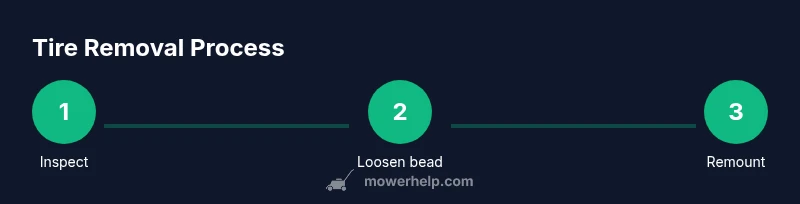
- Prepare and inspect the tire and rim; safety first.
- Deflate and lubricate the bead for easier release.
- Use levers or a bead breaker to loosen the bead gradually.
- Pry and rotate the bead off the rim in segments.
- Re-seat the tire with careful observation and gradual inflation.
- Inspect for perfect seating and no leaks.
Tools & Materials
- Bead breaker(Manual or hydraulic preferred for stubborn beads; ensure rim compatibility)
- Tire levers / levers with plastic tips(2–3 levers; use plastic or wood to avoid rim damage)
- Rubber mallet or hammer with protective tip(Soft impact to seat beads without damaging rim)
- Lubricant / soapy water(Dish soap diluted in water; spray bottle helps reapplication)
- Rim protectors or thick rag(Prevent scratches when prying)
- Gloves and safety glasses(Eye and hand protection)
- Penetrating oil (optional)(Use if corrosion is suspected)
- Work surface or stand(Stable, flat area to prevent rolling)
Steps
Estimated time: 60-90 minutes
- 1
Inspect tire and rim condition
Visually evaluate the tire for sidewall damage, tread separation, or nails. Check the rim for cracks, corrosion, or deformations. If either component shows significant damage, consider replacement before proceeding.
Tip: If you see deep corrosion or a cracked bead, stop and consult a professional. - 2
Deflate the tire completely
Puncture or remove the valve core to ensure all air escapes. Confirm there is no air pressure that could cause the bead to spring unexpectedly during levering.
Tip: Take a moment to wipe the bead and rim to remove debris. - 3
Apply bead lubricant around the bead
Spray or apply lubricant evenly from both beads. This reduces friction and helps the tire slide over the rim during removal.
Tip: Lubricant helps protect the rim finish and speeds up bead loosening. - 4
Insert the first tire lever at the bead
Gently slide the lever under the bead near the tire bead seat. Pry upward to create a gap between the bead and rim. Move to a new position after each lift.
Tip: Keep the lever at a low angle to avoid prying the rim edge. - 5
Work the bead around the rim in sections
Rotate the tire around the circumference, loosening the bead in small segments. Alternate sides to keep even pressure on the rim.
Tip: Don’t rush; small, steady progress prevents slips. - 6
Seek help with a bead breaker if needed
If the bead refuses to break with levers, apply a bead breaker according to its instructions and proceed slowly around the rim.
Tip: Protect the rim with a pad to avoid scratches. - 7
Remove the tire from the rim completely
Once one bead is free, work the other bead off the rim in the same way. Take care not to pinch the valve stem.
Tip: If the tire is stubborn, pause and reapply lubricant before trying again. - 8
Inspect and prepare for re-mount
With the tire removed, inspect both tire and rim for damage. Clean the bead seats and apply fresh lubricant before re-mounting.
Tip: Record any wear or damage so you know when to replace parts.
Got Questions?
What tools do I need to remove a lawn mower tire from a rim?
You’ll typically need tire levers, a bead breaker or lever-based method, a rubber mallet, lubricant, rim protectors, gloves, and safety glasses. Depending on the rim, you may also need penetrating oil for corrosion.
You’ll need tire levers, a bead breaker (or lever method), a rubber mallet, lubricant, rim protectors, gloves, and safety glasses.
Can I remove the tire without a bead breaker?
Yes. Many mower tires can be removed with levers and lubricant alone, especially if the bead isn’t too stubborn. Exercise patience and rotate around the rim.
Yes, you can remove the tire with levers and lubricant if the bead isn’t stubborn. Be patient and work around the rim.
What should I do if the bead won’t break?
Pause and reapply lubricant, check for corrosion, and consider a bead breaker if available. Do not force the lever with excessive force.
If the bead won’t break, pause, reapply lubricant, and consider a bead breaker. Don’t force it.
Is it safe to reuse the rim after bead removal?
Rims with visible damage or corrosion should be replaced. If the rim shows no cracks and the bead seats evenly, it can be reused after a careful inspection.
Only reuse a rim if it’s not damaged and seats the bead evenly; otherwise replace it.
When should I replace the tire or rim instead of removing it?
Replace if there are deep cracks, significant corrosion, or if the bead cannot seat properly after multiple attempts.
Replace if there are cracks, heavy corrosion, or the bead won’t seat after several tries.
How do I re-mount the tire after removal?
Clean the bead seats, apply lubricant around the rim, align the tire with the valve stem, and work the bead into place before gradual inflation.
Clean the seats, lubricate, align the valve stem, and seat the bead gradually while inflating carefully.
Watch Video
The Essentials
- Inspect the tire and rim for damage before starting
- Use proper levers and rim protectors to avoid scratches
- Release the bead evenly and work around the circumference
- Re-seat the tire carefully and check for leaks after mounting