Battery vs Gas Lawn Mower: Which Is Best for Your Lawn?
Explore how battery-powered and gas lawn mowers differ in power, runtime, maintenance, cost, and environmental impact to help you choose the right mower for your yard.


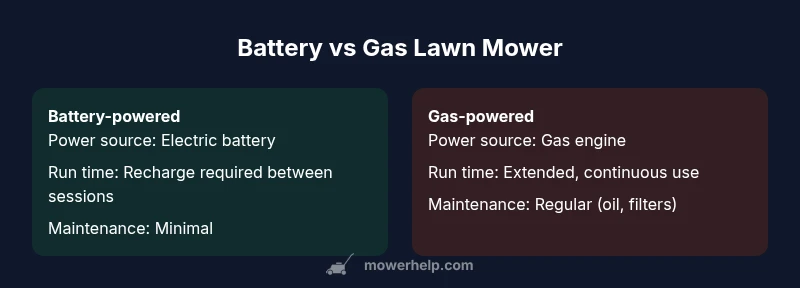
In most cases, a battery-powered lawn mower is the better choice for small to medium yards due to quiet operation, zero emissions, and minimal maintenance; gas mowers shine on large properties, tough terrain, and when you need instant, long-running power. If you value simplicity and low upkeep, battery wins; if you prioritize raw power and speed, gas is often the better option.
Overview: battery vs gas lawn mower in context
Choosing between a battery-powered and a gas lawn mower means balancing convenience, performance, and long-term costs. For homeowners, the landscape has shifted toward cordless options that are lighter, quieter, and easier to store, while traditional gas models still appeal to those with very large properties or severe terrain. According to Mower Help, the shift toward battery technology reflects a broader push toward cleaner operations, lower noise, and simplified ownership. Understanding the core distinctions—power source, run time, maintenance, and environmental impact—helps you make a decision aligned with your yard size and mowing style. As you evaluate, consider how often you mow, the terrain you tackle, and your tolerance for refueling or recharging. This context sets the stage for a balanced decision that respects both practicality and budget over time.
Power and Performance Differences
Powerful battery motors have closed a lot of gaps with gas engines, especially for typical residential lawns. Electric motors deliver steady torque with predictable performance, and modern cordless systems provide sufficient cutting power for moderate-dense grass and common lawn shapes. Gas engines still lead in raw peak power, quick throttle response, and consistent performance on very thick growth or uneven terrain. The key distinction is not just raw horsepower but how the power is delivered and managed: battery systems rely on battery chemistry and firmware for efficiency, while gas engines depend on fuel availability, air intake, and mechanical tuning. For the DIY homeowner, this means battery mowers are often easier to start and operate, while gas mowers maintain a reputation for handling extreme conditions with fewer concerns about discharge state.
Runtime, Refueling, and Charging Logistics
Runtime comes down to battery capacity and the mower’s load. A battery-powered mower spends time charging between sessions, which can extend gaps between mowing but also reduces downtime during use. Gas mowers offer near-infinite run time in the field, limited only by fuel supply and maintenance intervals. Refueling gas engines is quick but creates fumes and requires proper storage; charging a battery can be a longer process, yet charging stations and fast-charging options continue to improve. Consider your mowing cadence: if you only need brief sessions weekly, a battery mower can be perfectly adequate; if you anticipate long, uninterrupted sessions or frequent mowing of large spaces, a gas mower preserves momentum and minimizes interruptions.
Maintenance and Longevity
Maintenance needs are a primary source of ongoing cost difference. Battery-powered mowers have fewer moving parts and require minimal servicing beyond battery care, blade sharpening, and occasional firmware updates. Gas mowers demand regular oil changes, air filter cleanings, spark plug checks, and more frequent general inspection. Battery health degrades over time, affecting run time and performance; this makes long-term planning important, especially for owners who keep a mower for many seasons. Modern maintenance routines emphasize blade care, rust prevention, and seasonal checks for both types, but the relative effort and cost are still heavier for gas-powered systems. This block highlights the practical maintenance implications you should weigh when budgeting over several mowing seasons.
Cost of Ownership: Upfront and Running Costs
Upfront costs for battery systems can be higher due to the price of the battery pack and charger, while gas mowers often come with a lower sticker price. Running costs lean toward electricity versus gasoline, yet you must factor battery replacements after several years and potential charging equipment upgrades. Gas mowers incur ongoing fuel costs and regular maintenance expenses such as oil and spark plug replacements. The overall ownership picture depends on yard size, mowing frequency, and local fuel costs. For many homeowners, the reduced maintenance and lower noise of battery-powered mowers translate into meaningful savings over time, while others with demanding lawns find gas mowers more cost-effective over the long haul because they avoid charging cycles and battery replacements.
Environmental Impact and Noise
Battery-powered mowers produce zero tailpipe emissions during operation, contributing to a smaller environmental footprint on compact lawns and in urban settings. They generally operate much more quietly than gas engines, reducing noise disturbance and enabling earlier or later mowing without neighbor complaints. Gas mowers emit fumes and require regular maintenance, which adds to their environmental presence. For those who prioritize sustainable practices and strict noise limits, battery mowers often align with community regulations and personal values better than traditional gas-powered units. This consideration is increasingly important as cities and homeowners associations push for cleaner, quieter outdoor equipment.
Real-World Scenarios: Yard Size, Terrain, and Climate
Small to medium yards with flat or gently sloped terrain are well suited to battery-powered mowers, especially in climates with mild mowing seasons. If you have a large property, frequent heavy grass growth, or steep inclines, a gas mower can maintain momentum and reduce charging downtime. In damp climates, battery systems may experience battery temperature limitations; however, advances in battery chemistry and cooling systems mitigate these issues. When choosing, map your typical mowing tasks: routine maintenance of flower beds, fences, and tight corners is often easier with a compact battery mower, while the occasional heavy-duty mowing—territory-wide cutting, tall grass, or rough ground—may justify gas.
Buying Guide: How to Choose Between Battery and Gas
Start by defining yard size and mowing frequency. Next, assess terrain: flat lawns support battery options, while hills and dense growth may benefit from gas power. Consider storage space and charging availability—indoors charging reduces weather exposure, while garage storage may require longer cords or extension options. Evaluate total ownership costs, including battery health, fuel costs, and maintenance. Look at warranty terms: batteries often have shorter warranties than engines, but reputable brands balance this with service networks. Finally, test both types if possible and read hands-on reviews that reflect your climate and typical seasonal patterns.
Common Misconceptions Debunked
A common myth is that battery mowers cannot handle large lawns. In reality, many models now offer extended runtimes and fast-charging cycles suitable for typical suburban yards. Another misconception is that gas mowers are always more powerful; while gas engines can deliver more raw torque, electric motors provide instantaneous torque that often surpasses expectations on routine mowing. Maintenance costs are not always higher for gas; battery health and replacement costs can accumulate, especially if you keep a battery for many years. Finally, some buyers assume battery mowers are fragile and weather-sensitive; modern designs emphasize rugged construction and weather resistance, broadening their practical use cases.
Comparison
| Feature | Battery-powered mower | Gas-powered mower |
|---|---|---|
| Power source | Battery power (cordless, rechargeable) | Internal combustion engine fueled by gasoline |
| Run time / use duration | Limited by battery charge; recharge required between sessions | Typically long run times per session with quick refueling |
| Maintenance frequency | Low maintenance: blade care, battery health, firmware checks | Regular maintenance: oil changes, air filters, spark plugs |
| Noise level | Lower noise suitable for residential areas | Higher noise; may require hearing protection |
| Emissions | Zero tailpipe emissions during operation | Gasoline emissions during operation |
| Upfront cost | Higher initial cost due to battery and charger | Lower initial cost for gas mower |
| Running costs | Lower ongoing energy costs; charged at home | Ongoing fuel and maintenance costs |
| Best for | Small to medium yards, easy storage | Large yards, hills, and very dense grass |
Benefits
- Quiet operation and zero emissions during use
- Easy storage and quick startup
- Lower ongoing fuel costs for typical seasonal use
- Fewer moving parts reduce routine maintenance
Cons
- Higher upfront cost for battery systems
- Limited run time per charge and charging time
- Battery replacement costs over time
- Less power for very large or rugged lawns
Battery-powered mowers suit most homes; gas mowers excel for large, demanding lawns
Choose battery if you mow a typical-sized yard and value quiet, easy upkeep. Opt for gas if you handle big plots with rugged terrain and need maximum continuous power.
Got Questions?
What is the primary difference between battery and gas mowers?
The main difference is the power source: battery mowers run on rechargeable batteries with electric motors, while gas mowers use internal combustion engines powered by gasoline. This affects run time, maintenance, cost, and environmental impact. Battery mowers offer cleaner operation and easier startup, whereas gas mowers provide uninterrupted power for long, demanding sessions.
The primary difference is the power source: battery versus gas, which changes maintenance, costs, and use cases. Battery mowers are cleaner and easier to start; gas mowers excel for long, tough jobs.
Are battery mowers sufficient for typical residential lawns?
For most homes with regular mowing needs, battery mowers provide ample run time. If you have a very large yard or dense, tall grass consistently, you may experience longer recharge intervals. In many cases, a spare battery or a charging plan can keep you mowing with minimal downtime.
Most standard yards are fine with battery mowers, though very large lawns might require more planning for charging.
Do gas mowers require more maintenance than battery mowers?
Gas mowers generally require more routine maintenance, including oil changes, air filter cleaning, and spark plug checks. Battery mowers simplify upkeep to blade care and battery health. Regular blade sharpening remains important for both, but the ongoing service burden is typically higher with gas engines.
Gas mowers usually need more ongoing maintenance, while battery mowers focus on blade care and battery health.
Can battery mowers mulch or bag grass effectively?
Yes, many battery mowers come with mulching capabilities and bagging options. Availability depends on the model and deck design. If you prefer mulch, verify compatibility and choose a model with a mulching plug or dedicated mulch mode.
Most battery mowers can mulch or bag; check the model for mulch capabilities before buying.
What about upfront and running costs for battery vs gas?
Upfront costs for battery mowers may be higher due to the battery and charger, but running costs lean toward electricity rather than fuel. Gas mowers are cheaper to buy initially, but ongoing fuel, oil, and maintenance can add up over time. Total cost depends on yard size, mowing frequency, and local fuel prices.
Battery mowers cost more upfront but save on fuel; gas mowers are cheaper to buy but cost more to run.
Which mower is better for hilly terrain?
Gas mowers generally perform better on steep grades because you don’t worry about charging versus run time. Some high-end battery mowers offer robust torque, but their lighter weight can affect traction on very steep slopes. For extensive hills, gas is often the safer bet.
Gas mowers tend to be more reliable on hills, though strong battery models can handle moderate slopes.
The Essentials
- Assess yard size first to prioritize battery or gas
- Consider terrain and slope for sustained power
- Factor charging time into mowing schedule
- Weigh total ownership costs over several seasons
- Test models in real-world settings before buying