How to Keep Lawn Mower Battery from Dying: A Practical DIY Guide
Learn proven steps to prevent your lawn mower battery from dying. Seasonal care, charging habits, storage tips, and troubleshooting for reliable starts. A DIY-friendly, maintenance-focused approach by Mower Help.


Learn how to keep lawn mower battery from dying by following a simple routine of proper charging, regular maintenance, and smart storage. This guide outlines quick wins, seasonal checks, and troubleshooting steps to keep your mower starting reliably all season long, with practical tips, example schedules, and safety reminders. No guesswork, just proven steps.
Why battery dying happens: common causes
A lawn mower battery can die for several reasons, and understanding these factors helps you prevent future failures. In many cases, sulfation forms on the battery plates when the battery sits discharged too long, reducing capacity and ability to hold a charge. Parasitic drains from electronics, especially in mowers with extra sensors or radio accessories, can sap power even when the engine is off. Infrequent use accelerates self-discharge, as chemistries slowly lose charge over days or weeks. Temperature plays a big role too: extreme cold slows chemical reactions and increases the risk of a no-start condition, while heat can accelerate internal corrosion. Improper charging, using an incompatible charger, or letting the state of charge drift too low are common culprits. By recognizing these causes, you can tailor care to your mower’s battery type and usage patterns.
In this guide, you’ll see how to apply practical routines that align with the realities of home ownership. The goal is to keep the battery healthy throughout the mowing season, so you can avoid dreaded battery-induced starting issues. As always, follow safety precautions and consult your mower’s manual for model-specific guidance. According to Mower Help analyses in 2026, consistent charging and moderate storage conditions dramatically reduce dead-battery events for most homeowners.
Quick wins to prevent early death: fast, simple habits
Implementing small, repeatable habits adds up to big gains. After mowing, if possible, connect a compatible charger to top off the battery rather than leaving it at an uncertain state of charge. Use a charger that matches the mower battery’s chemistry (lead-acid, AGM, or lithium) and avoid high-amp bursts that can stress the plates. Regularly inspect terminal connections for looseness or corrosion; clean with a mild baking-soda solution and dry thoroughly before reconnecting. Keep the battery in a dry, cool, and well-ventilated area when not in use. If you store the mower indoors, consider a float or smart charger that maintains a safe trickle current without overcharging. These steps help preserve capacity and extend the time between full replacements.
To reinforce, never store a fully discharged battery for long periods. Even a few weeks of inactivity at low charge can reduce lifespan. By adopting a consistent charging and storage routine, you’ll notice fewer no-start days and reduced maintenance headaches.
Seasonal maintenance routine: spring, summer, fall, winter
Seasonal care aligns charging and storage with how you use the mower. In spring, perform a full battery inspection, clean terminals, and verify charger compatibility before the first uses of the season. During summer, keep the battery topped up after each major mowing session, especially in hot climates where self-discharge can be faster. In fall, test the battery’s remaining capacity and top off before winter storage. For winter, if you won’t mow for extended periods, store the battery in a temperature-controlled space and attach a float charger to prevent self-discharge. Each season should include a quick voltage check with a multimeter, terminal cleaning, and a visual inspection for signs of swelling or leakage. These steps form a dependable cycle to keep the battery healthy year-round.
Mower Help’s research indicates that homeowners who follow seasonal checks experience more reliable starts and longer battery life across multiple mowing seasons.
Safe charging practices and choosing a charger
Charging correctly is foundational to keeping a lawn mower battery from dying. Use a dedicated charger designed for the battery’s chemistry and a charging rate that matches the battery’s capacity without pushing it beyond safe limits. Avoid using car chargers or high-current power supplies that aren’t intended for lawn mower batteries. Keep the charging area away from moisture and direct sunlight, and ensure the charger’s cords are in good condition to prevent heat buildup. If your mower sits unused for weeks, a trickle charger or a smart charger that maintains a gentle, automatic charge is preferable to leaving the battery idle. Regularly inspect the charger plug and cable for wear, and store the charger in a dry location when not in use.
These practices reduce the risk of sulfation, mineral buildup, and excessive heat, all of which shorten battery life over time.
Storage and climate considerations: where and how to store
Where you store the battery matters almost as much as how you charge it. Aim for a cool, dry, well-ventilated area with a stable temperature, ideally between roughly 50–77°F (10–25°C) depending on your battery type. Keep batteries off concrete floors, which can conduct cold and dampness; place them on a wooden shelf or mat to minimize contact with cold surfaces. Disconnect the battery from the mower when storing for extended periods to prevent parasitic drain. If possible, use a maintenance charger that keeps the battery at a safe state of charge. Avoid extreme heat or freezing conditions, as these accelerate internal chemical changes and shorten life. Regular checks for swelling, leaking, or corrosion are essential, and replace damaged batteries promptly.
The goal is to minimize lurking drains and environmental stress that can quietly shorten battery life when the mower sits idle.
Troubleshooting: signs your battery needs attention
If your mower fails to start or starts weakly, that’s a clear signal to diagnose the battery first. Look for slow cranking, dim lights, or a noticeable drop in voltage when under load. Check the terminals for corrosion, loose connections, or white/blue powdery buildup and clean as needed. Test the voltage with a multimeter: a healthy 12V lead-acid battery typically sits around 12.6V or higher when fully charged, though exact values vary by chemistry. If voltage remains low after a full charge, the battery may be reaching end of life and require replacement. A battery that swells, leaks, or emits an odor should be retired immediately for safety reasons. For borderline cases, consider desulfation or professional testing, but be mindful that not all batteries respond to desulfation attempts. Mower Help advises cautious evaluation before deciding to replace.
These diagnostic steps empower you to distinguish an easy fix from a true failure, avoiding unnecessary replacements.
Replacement vs. maintenance: making the right call
When a battery no longer holds charge after proper maintenance and charging, replacement is often the practical option. Consider the cost and availability of a compatible battery for your mower model, and weigh the long-term warranty coverage from the manufacturer. If you’re using a lithium-based battery, care includes prioritizing proper charging cycles and avoiding deep discharges. In contrast, lead-acid or AGM batteries benefit from regular top-offs and careful storage. Replacement timing depends on usage frequency, climate, and whether the battery has swollen or leaked. A fresh battery can restore reliable starts and reduce downtime, especially for households that rely on mowing on weekends or during growing seasons.
Mower Help’s guidance is that proactive maintenance saves money and reduces frustration compared with waiting for a failure to prompt replacement.
Tools & Materials
- 12V lawn mower battery charger(Charger suitable for your battery chemistry (lead-acid/AGM/Li-ion); avoid high current surges)
- Multimeter(To test voltage and charging state of the battery)
- Wire brush or cleaning brush(For removing corrosion from terminals)
- Safety gear (gloves and eye protection)(Protect from acid and spark hazards during maintenance)
- Screwdriver or wrench(To disconnect battery safely from the mower)
- Distilled water (for flood-type batteries)(Only if your battery type requires topping up electrolyte)
Steps
Estimated time: 30-60 minutes
- 1
Inspect battery and terminals
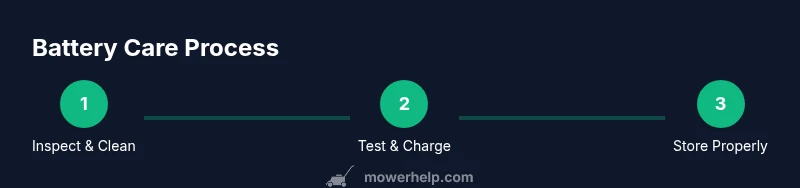
Power down the mower and remove the key. Put on safety gear, then visually inspect the battery case for cracks or swelling. Check the terminal posts for corrosion, loose connections, or white powdery residue. If you see corrosion, disconnect the battery and clean the terminals with a baking-soda solution, then wipe dry. Reconnect and snug the cables without overtightening.
Tip: A clean connection reduces resistance and maximizes charge efficiency. - 2
Test voltage and charge state
Using a multimeter, measure resting voltage with the battery disconnected from the mower. A healthy 12V lead-acid battery typically shows around 12.6V when fully charged; anything under 12.4V indicates a low state of charge needing a recharge. If you notice rapid voltage drop under light load, the battery may be nearing end of life.
Tip: Keep the battery at a stable charge before testing for accurate results. - 3
Charge with the correct charger
Connect the charger designed for your battery chemistry and allow it to bring the battery to a full state of charge. Avoid high-amp charging that can overheat the plates, especially for older batteries. Monitor the charger during initial sessions and disconnect once the battery reaches full charge as indicated by the charger.
Tip: Use a smart or float charger for extended storage to prevent overcharging. - 4
Check for parasitic drains
If the battery loses charge while the mower is idle, there may be a parasitic drain. With the mower off, disconnect the negative terminal and use a multimeter to check for current draw. If you observe current flow above a very small baseline, locate the accessory or module causing the drain and disable or replace it.
Tip: Parasitic drains are common in models with added accessories; address them promptly. - 5
Clean and protect terminals
After cleaning, apply a light coat of terminal protectant spray or petroleum jelly to prevent future corrosion. Reconnect the terminals in the correct polarity and ensure they’re snug but not overly tight.
Tip: This simple step extends contact quality and charging efficiency. - 6
Store correctly between uses
If you won’t mow for more than a week, disconnect the battery and store it in a cool, dry place. Use a maintenance charger to keep the battery topped up during long idle periods. Avoid storing on concrete; place the battery on a non-conductive surface.
Tip: Long storage benefits from a steady, moderate charge rather than complete discharge.
Got Questions?
Can a dead battery recover after sulfation?
Sulfation can sometimes be reversed with desulfation charging, but many batteries do not fully recover and may require replacement. Regular charging and avoiding prolonged discharges reduces sulfation risk.
Sulfation can sometimes be reversed with desulfation charging, but often replacement is needed. Regular charging helps prevent it.
How often should I charge a lawn mower battery?
Charge the battery after use when possible and top it up regularly during periods of inactivity. Avoid letting it stay in a low state of charge for extended times.
Charge after use and top up during inactivity to avoid deep discharges.
Is it better to store a battery attached to the mower or detached?
Detaching the battery during long storage reduces it from parasitic drain. If you store attached, use a smart charger to maintain a safe charge level.
Detach for long storage, or use a smart charger if you keep it connected.
What battery type is best for most lawn mowers?
Most mowers use lead-acid or AGM batteries, though some newer models use lithium. Follow the manufacturer’s recommendation for compatibility and charging.
Lead-acid or AGM are common; check your model’s spec for compatibility.
My mower won’t start even with a new battery—what else?
Check starter connections, fuses, and safety interlocks. A poor connection or a fault elsewhere in the starting system can prevent a start even with a healthy battery.
If a new battery doesn’t start it, inspect connections and other starting components.
What maintenance log entries are most helpful?
Record dates of charging, voltage readings, observed symptoms, and any replacements. This helps identify patterns and informs future maintenance decisions.
Keep dates, voltages, symptoms, and replacements in a simple log.
Watch Video
The Essentials
- Identify and fix corrosion for reliable starts
- Charge with the correct charger to avoid damage
- Store properly to minimize self-discharge
- Test voltage regularly to catch aging batteries early
- Choose replacement when capacity is irreversibly low