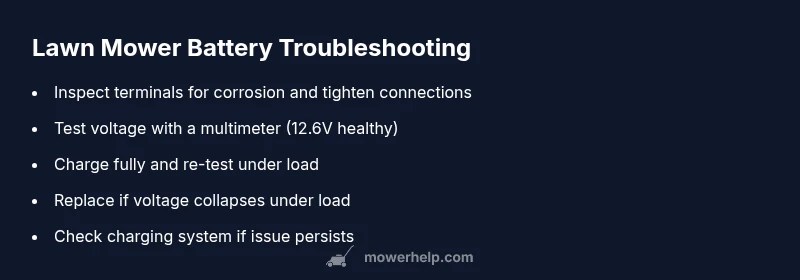
How to Tell If Your Lawn Mower Battery Is Dead: Quick Troubleshooting
Learn how to tell if your lawn mower battery is dead with simple tests, safety steps, and clear fixes. From voltage checks to replacement tips, get back to mowing fast with expert guidance from Mower Help.


Most lawn mower batteries are dead if the engine won’t crank, the starter sounds weak, or the battery shows no voltage on a test. Start with a quick check: measure voltage with a multimeter, inspect terminal connections, and attempt a full charge. If the voltage remains low after charging, replace the battery. For a thorough diagnosis, follow our step-by-step guide.
What 'dead battery' looks like and quick tests
If you’re trying to start your mower and nothing happens, the issue is often a dead battery. The Mower Help team notes that the most common signs are the engine refusing to crank, a humming or clicking noise from the starter, and voltage readings near zero. Before you dive into deeper fixes, perform a quick check to confirm whether the battery is the culprit. Start with a visual inspection for corrosion, loose terminals, or damaged wires. Then test the voltage with a multimeter: a healthy 12-volt battery typically reads around 12.6 volts when fully charged (or slightly higher). If you see numbers well below this, the battery is probably dead or near end-of-life. In that case, charging is worth trying, but replacement may be necessary for long-term reliability. This is a common issue homeowners face, and acting quickly can save you time and a tow to a shop.
According to Mower Help, addressing the battery first often resolves the mowing delay. If your readout jumps after a charge but falls again under load, the battery’s capacity is compromised and replacement is likely the best path. Keeping a spare battery or a portable charger on hand is a smart hedge against downtime during peak season.
Safety first before you test (protect yourself and the mower)
Safety always comes before troubleshooting. A lawn mower battery can deliver a painful shock or leak acid if mishandled. Wear eye protection and gloves, work in a dry area, and keep flames, sparks, and metal tools away from the battery terminals. If you have an exposed battery, gently disconnect the negative cable first, then the positive, and store the cables so they won’t touch. After testing or charging, reconnect in reverse order and secure all clamps firmly. When in doubt about any step, stop and consult a professional. Following these precautions minimizes risk and protects both you and your mower’s electrical system. Mower Help emphasizes safety as the foundation of any diagnosis.
Battery health basics: voltage, age, and charge cycles
Battery health hinges on more than a single voltage reading. A fresh, healthy 12-volt lead-acid battery typically sits around 12.6 volts when idle and full of charge. If the voltage drops quickly under a slight load, the battery may be fatigued even if it reads okay at rest. Age matters too: most lawn mower batteries last roughly 2–5 years depending on climate, usage, and charging habits. Cold weather can further reduce available cranking amps and mimic a dead battery. If a battery tests above 12.4 volts but cannot sustain load, it’s near the end of its life. The practical takeaway is to distinguish temporary voltage dips caused by a discharge from deeper capacity loss requiring replacement. Maintaining charge and avoiding deep discharges are key to long-term reliability.
Quick tests you can perform at home (no special tools required)
Begin with these at-home checks so you don’t miss the obvious issues. Visual inspection for swelling, cracks, or acid leaks is essential—do not use a swollen battery. Clean corrosion from terminals with a wire brush and apply terminal protector to prevent future buildup. Use a multimeter if available: a fully charged battery should show approximately 12.6V with the engine off; readings below 12.0V typically indicate a discharged or failing cell. If you have a smart charger with an integrated load test, perform a 15-second load test to see if voltage holds. If the battery cannot sustain voltage under load after charging, replacement is recommended. Always test the mower’s wiring and fuses if electrical symptoms persist. Safety first, then methodical testing.
When to charge vs replace: making the call
Charging a battery can revive a temporary discharge, but it won’t restore performance in aged cells. If a full charge still fails to deliver adequate cranking amperage, replacement is the sensible choice. When selecting a replacement, verify the cold-crank amps (CCA) match your mower’s requirements and avoid mixing old and new batteries on systems that require consistent output. For riding mowers, replacing both the battery and any related components (like the alternator or control module, if applicable) is wise to prevent short-term failures. After replacement, secure the battery, reconnect cables correctly, and perform a start test to confirm the fix.
Steps
Estimated time: 25-40 minutes
- 1
Gather tools and safety gear
Collect a multimeter, wrench, brush, terminal protector, gloves, and eye protection. Ensure the mower is off and cooled before you start. Clear the area around the battery to avoid accidents.
Tip: Having a helper nearby can keep you safe and speed up the process. - 2
Locate and inspect the battery
Find the battery compartment, inspect for swelling, leakage, or cracks. Look at terminals for corrosion or loose connections. Note cable routing to ensure you won't accidentally cause a short when testing.
Tip: If you see swelling or leakage, do not test—replace immediately. - 3
Test voltage with a multimeter
Set the meter to the DC voltage range and connect the probes to the battery terminals. A healthy, fully charged 12V battery should read about 12.6V with the engine off. If the reading is well below, charge or replace as needed.
Tip: Record the voltage before and after charging for comparison. - 4
Charge and re-test under load
Connect a compatible charger and charge for 6–12 hours, then re-test both no-load and under-load voltage. If voltage collapses under load, the battery likely has deteriorated cells.
Tip: Never leave a charging battery unattended for long periods. - 5
Check the charging system
With the battery installed, run the mower and check for steady voltage at the terminals. If the voltage doesn’t rise above 13.5V while running, the charger or alternator may be failing.
Tip: A professional with a load tester can confirm the charging system’s health. - 6
Replace or reinstall and test start
If you’ve determined the battery is dead or the charging system is healthy, install a new battery of the correct type. Reconnect terminals securely and attempt a start. Confirm that the mower starts smoothly and runs without reluctance.
Tip: Dispose of old batteries properly at a recycling center.
Diagnosis: Mower won't start or starts intermittently; battery reads low voltage on test
Possible Causes
- highBattery voltage is too low or discharged
- mediumCorroded or loose terminals
- highOld battery or failed cells
- lowFaulty charging system or alternator
Fixes
- easyCharge the battery fully and re-test under load; if it drops below ~10V under load, replace
- easyClean terminals and reseat connections; apply protector to prevent future corrosion
- mediumReplace old or failed battery; ensure correct CCA rating for your mower
- mediumCheck charging system/alternator and fuses; repair as needed or consult a professional
Got Questions?
Can a dead lawn mower battery be revived by charging alone?
Charging can revive a battery if it is merely discharged and the cells are still good. If the voltage drops under load or the battery won’t hold a charge, replacement is usually required. Always test under load to confirm.
Charging can revive a discharged battery, but if it can’t hold a charge, you’ll need a replacement.
What voltage indicates a dead lawn mower battery?
A healthy battery typically reads around 12.6V when idle. Readings below 12.0V suggest a discharged or failing cell, and may indicate the need for charging or replacement. Always re-test after charging.
Under 12 volts usually means the battery is dead or near death; charge and test again.
Is it safe to jump-start a lawn mower battery?
Jump-starting can be risky with small mower batteries and may damage electronics. If you jump-start, use proper polarity, a compatible charger, and avoid shorting leads. Prefer charging directly or replacing a faulty battery.
Jump-starting is risky; use a charger or replace if necessary.
How long should a mower battery last?
Most mower batteries last about 2–5 years, depending on climate, cycling, and maintenance. Regular charging and avoiding deep discharges extend life. If your battery is older or shows rapid voltage loss, plan for replacement.
Most mower batteries last a few years; if it dies fast, plan a replacement.
What if the battery is swollen or leaking?
A swollen or leaking battery is dangerous. Do not charge or use it; dispose of it immediately through a proper recycling channel and replace with a safe unit.
A swollen battery must be replaced and disposed of safely.
Can I recondition a lawn mower battery?
Most homeowner-grade batteries aren’t reliably reconditioned. If a battery repeatedly fails after charging, replacement is typically the best option. For specialized cases, consult a professional.
Reconditioning is often not reliable; replacement is usually best.
Watch Video
The Essentials
- Test battery voltage first to confirm discharge
- Clean and protect terminals to prevent recurring issues
- Charge may revive a fresh battery but not old cells
- Replace with correct CCA rating to ensure reliable starts