Striper Kit for Lawn Mower: How to Stripe Your Lawn
Learn how to choose, install, and use a striper kit for lawn mowers to create professional stripes. This guide covers compatibility, mounting, calibration, and maintenance for DIY homeowners.


You can stripe your lawn with a striper kit for lawn mower by mounting the kit on your mower and adjusting wheel height. Verify compatibility with your mower model, install the kit per the manufacturer, and calibrate stripe width. Plan 30-60 minutes for setup and 15-30 minutes for a test pass.
What is a striper kit for lawn mower and how it works
A striper kit for lawn mower is an attachment that gives your mower a guided path to create visible stripes on a freshly cut lawn. The kit typically includes guide wheels, brackets, and a mounting interface that attaches to the mower chassis and to the rear or sides. When you mow, the wheels ride along the lawn, creating a narrow trail of longer grass that contrasts with the cut area; the result is a parallel pattern that looks like a professional lawn finish.
In practice, stripes are created by the width of the wheel track and the timing of the mowing path. The kit ensures the stripe width stays consistent by maintaining a fixed distance between the trailing edge of the deck and the stripe guide wheel. Many kits offer adjustable width, allowing you to customize stripe density. Importantly, a good kit does not affect mowing height; it simply guides where the mower passes, so you still choose your standard cut height and pattern orientation (forward vs. backward passes).
Benefits and trade-offs of using a striping kit
A striper kit can dramatically improve the visual appeal of your lawn, giving you crisp, salon-like stripes that highlight mowing patterns. For many homeowners, the payoff is aesthetic—your lawn looks professionally maintained with less effort. Striping also helps you gauge evenness across the turf and can improve mowing discipline, since you maintain a consistent path to avoid patchy lines.
However, there are trade-offs to consider. The added hardware increases the weight near the deck, which can marginally affect mowing speed and fuel use on larger lawns. Some kits require a specific mounting style or extra maintenance, and not all mower models support every kit. Finally, extremely soft or uneven ground may produce imperfect stripes, even with a high-quality kit. If you value a pristine look, be prepared to invest time in setup and occasional re-calibration.
Compatibility: what to check before buying
Before choosing a striper kit for lawn mower, confirm compatibility with your exact mower model. Look for mounting points that align with your deck or frame, and verify that the kit won’t interfere with grass catcher mechanisms or discharge chutes. Check wheelbase, deck width, and whether the kit is rear-mounted, front-mounted, or wheel-based. Powertrain considerations matter too: heavier kits can stress older, smaller mowers, while newer models often tolerate the extra load more gracefully. Finally, review any maintenance requirements or warranty implications—some kits require periodic tightening of bolts or occasional lubrication to keep stripes even.
According to Mower Help, choosing a kit that matches your mower’s mounting geometry often yields the most reliable stripes and minimizes pre-mow prep.
How to measure stripe width and set your kit
Stripe width is determined by how far the guide wheels ride from the cutting path. Start by measuring the distance between the stripe edge and the mower deck edge when the kit is mounted. Use a tape measure for precision and note the measured width in inches. Then adjust the kit’s guide wheel position to your desired stripe width, keeping the deck height constant. After mounting, perform a test pass on a patch of grass, compare the stripe against the line you drew, and adjust if needed. Maintaining consistent blade height across passes helps keep stripes uniform across the entire lawn.
Mounting options: rear-mounted, front-mounted, and wheel-based
Striper kits come in several mounting configurations. Rear-mounted kits often offer the simplest alignment with the mower’s existing drive path, making it a popular choice for walk-behind mowers. Front-mounted kits position the guides ahead of the deck, which can produce crisper lines on certain mowing patterns but may require more careful steering. Wheel-based systems use external wheels that ride on the turf to create the line, which can reduce deck wear but sometimes introduce slight drift on uneven ground. Your choice will depend on your mower type, your preferred mowing pattern, and how easy it is to access mounting points during installation.
Installation checklist and setup workflow
Start with a clean workspace and read the kit manual. Confirm all mounting brackets are present and match your mower. Loosen hardware only enough to position the kit, then snug bolts incrementally to the manufacturer’s torque spec. Attach any linkage to the drive or wheel as instructed and verify all moving parts clear the blade and deck. Finally, recheck alignment with a straight edge, and set the stripe width to your preferred dimension. This workflow minimizes rework and helps you avoid misalignment.
Calibration and test passes: getting those bold stripes
Calibration is about consistency. After mounting, set the stripe width and perform a slow-speed test pass on a turf patch. Observe stripe edges for waviness or drift and adjust wheel tension or alignment as needed. For the first real mowing, choose an easy, straight path and use faint lines on the grass as a guide. If stripes appear uneven, revisit wheel alignment, deck height, and tire pressure (where applicable). Re-test and record the final width setting for future sessions.
Maintenance and care for longevity
To keep your striper kit performing well, clean the wheels and brackets after each use to prevent grass buildup and corrosion. Periodically inspect mounting bolts for tightness and re-torque if the kit’s vibration loosens them. Lubricate moving joints per the manufacturer’s guidance and replace worn parts promptly. Store the kit in a dry area to prevent rust and material fatigue that could affect stripe precision in the long term.
Troubleshooting common issues
If stripes drift or appear uneven, suspect misalignment or wheel wear. Check that all adjustment screws are secure and that the wheels rotate freely without wobble. Debris buildup can also cause drift; clean the wheel guides and re-check clearance. If the pattern is consistently off in one section, re-measure stripe width and retighten all connection points. In some cases, moving to a slightly different stripe width resolves slight inconsistencies caused by grass density.
Real-world test scenarios: grasses, mowing patterns, and lawn types
Different grasses and soil conditions respond differently to striping. On dense, taller turf, stripes may appear softer; adjust blade height and ensure the kit’s guide wheels engage the ground evenly. For zigzag or circular mowing patterns, consider front-mounted kits if you need guides ahead of the deck for stable lines, and choose a stripe width that complements your mowing speed. On slope or uneven lawns, test multiple passes at a low speed to avoid drift or misalignment.
Safety considerations when installing and using stripe kits
Safety first: always disconnect the spark plug and remove the key before performing any mounting or maintenance work. Wear protective gloves and safety glasses, and work on a flat, stable surface to prevent slips. Avoid loose clothing or jewelry that could snag on moving parts. After installation, test the kit at low speed to ensure there are no unexpected interactions with the mower’s drive system.
Quick-start plan for beginners
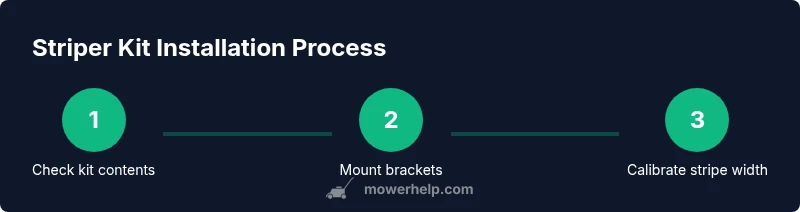
- Verify mower compatibility and kit contents. 2) Mount brackets and secure the kit per instructions. 3) Set stripe width and test on a patch of grass. 4) Make a straight test pass, adjust if necessary, and record your preferred settings. 5) Mow a full small lawn to confirm consistency before tackling larger areas. 6) Perform regular checks and maintenance after each mowing session.
Tools & Materials
- Striper kit for lawn mower(Ensure compatibility with your mower model and deck width)
- Socket wrench set(Includes a range of metric and SAE sizes)
- Phillips and flat-head screwdrivers(Essential for brackets and fasteners)
- Adjustable wrench(Useful for odd-sized bolts)
- Safety gloves(Protect hands during mounting)
- Safety glasses(Eye protection during setup)
- Tape measure (6 ft)(Accurate stripe width measurements)
- Chalk line or spray painter(Helpful for initial alignment marks)
- Replacement bolts and screws(Keep on hand in case of wear)
- Lubricant or penetrating oil(Ease mounting and prevent seizing)
- Rubber mallet(Gentle taps to align brackets)
- Owner's manual or installation guide(Kit-specific instructions)
Steps
Estimated time: 60-120 minutes
- 1
Unbox kit
Open the kit packaging and verify every part against the parts list. Confirm you have brackets, wheels, spacers, and mounting hardware. Review the installation guide to understand the sequence.
Tip: Take photos of each step to reference later. - 2
Inspect contents
Lay out all components on a clean surface. Check for any damage or missing hardware. If anything is missing, contact the supplier before proceeding.
Tip: Double-check parts compatibility with your mower model. - 3
Prepare mower
Park on a flat surface and disconnect the spark plug to prevent accidental starts. Clean the mounting area and ensure there is clear access to mounting points.
Tip: Wear gloves and safety glasses while working. - 4
Mark mounting points
Use the kit guide to identify where brackets will attach to the chassis or deck. Mark alignment lines with a chalk line if needed.
Tip: Accurate marks save time during installation. - 5
Attach mounting brackets
Position brackets at the marked points and loosely fit bolts to allow final adjustments. Do not over-tighten yet to avoid misalignment.
Tip: Start with one side to maintain balance. - 6
Mount wheel assembly
Attach the wheel assembly to the brackets as per instructions. Ensure wheels rotate freely and align with the intended mowing path.
Tip: Check wheel clearance to avoid contact with blades or grass catcher. - 7
Tighten hardware to spec
Secure all bolts to the torque recommended by the kit, verifying that brackets stay aligned when tightened.
Tip: Use a torque wrench if the manual specifies a torque value. - 8
Adjust stripe guides
Set the stripe guides to your desired width by moving the wheel position. Record the setting for future mowing.
Tip: Small adjustments can significantly affect stripe width. - 9
Check clearance and alignment
Spin the wheels by hand to confirm smooth travel and verify there’s no rubbing on the deck or tires.
Tip: A loose bracket can cause drift in stripes. - 10
Conduct a patch test
Mow a short patch at low speed to see how stripes appear. Note any drift or waviness and adjust accordingly.
Tip: Start with a light pass to avoid overworking the kit. - 11
Calibrate stripe width
If stripes are too wide or narrow, fine-tune the guide wheel position and re-test until satisfied.
Tip: Maintain a consistent mowing height to avoid depth variations. - 12
Final check and storage
Do a full sample pass, verify stripe uniformity, then store tools and kit properly after use.
Tip: Document the final settings for next season.
Got Questions?
Will a striping kit fit every mower?
No. Compatibility depends on mounting points, deck width, and drive configuration. Check the kit’s fitment guide and your mower’s specs before purchasing.
Not all mowers support a striping kit. Check mounting points and deck width before buying.
Do stripes damage the mower or grass?
Properly used, stripes do not damage grass. Maintain appropriate mowing height and avoid forcing the kit beyond its design limits.
Stripes don’t harm grass if you mow at the right height and speed.
How do I align stripes for consistency?
Use a straight reference line and keep a constant mowing direction. Recheck stripe width after every few passes.
Keep a straight line and test width often for consistent stripes.
Can I remove the kit easily after mowing season?
Yes. Most kits are bolt-on and designed for seasonal removal. Keep fasteners organized for re-installation.
Yes, most kits come off easily with basic tools.
What maintenance is needed for the kit?
Clean after use, check bolts for tightness, and lubricate moving joints as recommended by the manufacturer.
Clean and check bolts; lubricate joints as advised.
Are there cheaper DIY stripe methods?
Some homeowners improvise using guides or tape, but this won’t provide the same consistency as a purpose-built striper kit.
DIY guides can work but won’t be as consistent as a dedicated kit.
Watch Video
The Essentials
- Choose a compatible kit that matches your mower's mounting points.
- Measure and set stripe width precisely before mowing.
- Test on a patch first to ensure alignment and pattern quality.
- Regularly inspect and maintain mounting hardware for longevity.