How to Achieve the Correct Lawn Mower Blade Position
Master the correct lawn mower blade position with this practical, safety-focused guide. Learn orientation, torque, testing, and maintenance for cleaner cuts and longer blade life.


To achieve the correct lawn mower blade position, power off the mower, disconnect the spark plug, and remove the blade safety cover. Align the blade so the sharp edge points forward and away from the mower deck, then install the blade with the correct orientation and torqued nut to specification. Recheck clearance and perform a test cut on a safe patch.
Why the correct lawn mower blade position matters for performance
According to Mower Help, the correct lawn mower blade position significantly affects cutting efficiency, deck wear, and operator safety. The blade controls the throw of clippings and the final surface finish, so misalignment can leave ragged edges or scalped patches. A properly positioned blade reduces vibration, which preserves engine health and prolongs spindle life. The cutting edge should meet the ground at the intended angle without tilting the blade toward the deck; this ensures consistent height control across your lawn and minimizes the risk of blade contact with foreign objects. When you set the blade position correctly, you’ll notice fewer pass attempts to achieve a clean cut, faster mowing sessions, and a more even appearance of your turf. Remember that the blade orientation also affects how the mower handles obstacles; an incorrectly oriented blade can pull toward a wall or plant edge, increasing the chance of kickback. Homeowners who regularly maintain blade position report fewer squeaks, quieter operation, and less debris buildup on the deck.
How blade position impacts cut quality and safety
The blade position determines the arc of the blade and the area exposed to the cutting edge. A blade set too far forward can leave long stringers of grass and uneven stubble. A blade set too far back or upside down may cause scalping on uneven terrain or mulch wrong. The blade’s orientation relative to the mower’s airflow (defined by the deck and chute) influences suction, clumping, and discharge pattern. Safety is improved when the blade sits flush with the mounting surface and the sharpened edge is not facing the user or any maintenance component. Keeping the blade level across the spindle ensures that the height adjustment you set translates into even clippings, reduces wear on the belt and pulley system, and lowers the risk of thrown objects. In both gas and electric mowers, vibration is often an early indicator of misalignment, which can lead to fast wear on bearings. A correctly positioned blade helps keep the engine cooler by maintaining balanced load, which translates to better fuel efficiency and longer service life.
Understanding blade orientation marks and spindle alignment
Most mower blades have a flat back and a beveled edge; the correct blade position aligns the bevel to meet the ground and directs grass toward the deck’s discharge path. Look for alignment notches or stamped marks on the blade hub and deck to confirm orientation. Before removing the blade, note which side faced upward and which side faced forward; many blades have a slightly curved camber that must align with the spindle. When reinstalling, ensure the blade sits flat against the spindle adaptor and sits within the blade washer or spacer if used. Some models require a reverse thread on the arbor nut to prevent loosening during operation; check your manual. Misalignment may cause the blade to rub on the muffler or housing, producing heat and noise. Always verify clearance by rotating the blade by hand to ensure no contact with any part of the mower and that the blade doesn’t wobble.
Step-by-step: setting the correct blade position
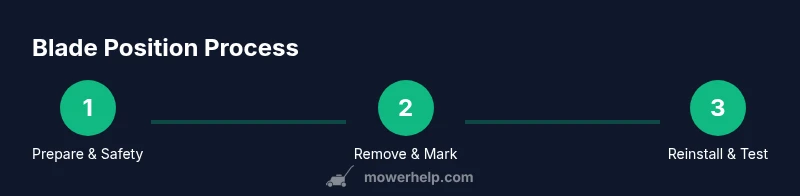
To begin, power off the mower and remove the spark plug cap to prevent accidental starts. Then remove the blade cover and locate the blade spindle. Align the marks or flat surfaces so the edge faces forward. Reinstall the blade with its sharp edge pointing in the correct direction, using the appropriate spacers or washers. Tighten the arbor nut to the manufacturer’s torque specification, ensuring the blade is securely fastened and perfectly flat. Finally, reattach the cover, reconnect the spark plug, and perform a low-risk test cut on a patch of tall, uniform grass to confirm the position.
Common mistakes and how to avoid them
Common mistakes include installing the blade upside down, not aligning the bevel correctly, over-tightening or under-tightening the arbor nut, and neglecting to set the deck to the proper height before testing. Another frequent issue is ignoring blade balance, which causes vibration and wear. To avoid these, double-check orientation marks, use a torque wrench to reach the recommended torque, and test on a flat, safe area after installation. Do not attempt maintenance with the spark plug connected or the battery connected. If the blade shows visible damage, replace it rather than attempting to adjust its position.
Verifying position after reinstall and test cut
After reinstalling, rotate the blade by hand to ensure there’s no rub and that the edge clears the deck. Listen for unusual sounds as you spin it; a squeak can indicate misalignment or a loose nut. Perform a test cut on a small patch of grass and inspect the cut: even height, uniform clippings, and no scalping. If you see off-center results, recheck the blade orientation and torque. Keep a log of the torque setting and any observations to guide future maintenance.
Maintenance tips to keep blade position correct long-term
Regular maintenance includes inspecting blades for nicks and wear, sharpening safely, and rechecking screws and spacers. Schedule a routine every mowing season to verify the blade is co-planar with the deck. Use a blade balancer to detect imbalance, and replace blades that have multiple nicks or curled edges. Clean the blade shaft and mounting area to prevent debris from pushing the blade out of alignment. Store the mower correctly and avoid hitting obstacles that can bend the blade or misalign the spindle.
Authority sources and safety references
For further safety guidance, refer to trusted industry resources: https://www.osha.gov, https://www.cpsc.gov, and https://extension.illinois.edu. These sources cover mower safety basics, debris hazards, and maintenance best practices to help you keep your equipment in top condition and your yard safe.
Tools & Materials
- Spark plug wrench or socket(Disconnect spark plug cap before starting)
- Socket wrench/set compatible with arbor nut(Size varies by model (common 3/8" or 1/2"))
- Torque wrench(To match manufacturer torque specification)
- New mower blade (correct deck type)(Ensure correct blade type for your mower)
- Gloves(Sturdy gloves to protect hands)
- Safety glasses(Eye protection)
- Rag or cleaning cloth(Wipe debris and clean spindle area)
- Owner’s manual(Torque specs and orientation marks)
Steps
Estimated time: 20-30 minutes
- 1
Power off and prepare safety area
Ensure the mower is on a flat, stable surface. Remove the ignition key or disconnect the spark plug cap to prevent accidental starts. Gather all tools and wear gloves and safety glasses before touching the blade.
Tip: Always verify the mower cannot start by attempting to turn the engine over by hand with the spark plug cap removed. - 2
Remove cover and blade from spindle
Remove the blade cover and expose the arbor nut. Use a socket wrench to loosen the nut just enough to free the blade without letting it drop abruptly. Keep track of any washers or spacers.
Tip: Note the exact order of washers/spacers; a missing piece can affect alignment. - 3
Check blade orientation and marks
Inspect the blade for orientation marks and note which side faced up and forward. If your blade lacks marks, photograph or mark the orientation before removal to ensure correct reinstallation.
Tip: Photo notes help prevent misassembly and save time. - 4
Position blade with edge forward
Place the blade on the spindle with the sharp edge facing forward and against the direction of travel. Align any marks with the deck or hub as described in your manual.
Tip: Do not force the blade; if alignment feels tight, re-check the marks and spacers. - 5
Torque and secure the blade
Tighten the arbor nut to the manufacturer’s torque specification using a torque wrench. The blade must sit flat against the spindle with no wobble.
Tip: Over-tightening can strip threads; under-tightening can allow the blade to loosen during use. - 6
Reassemble and test safely
Reattach the blade cover, reconnect the spark plug, and ensure guards are in place. Start with a dry, safe patch of grass to verify the cut and listen for unusual noises.
Tip: If you hear grinding or rattling, stop and recheck orientation and torque. - 7
Record and monitor
Document the torque setting and any observations from the test cut. Revisit blade position as part of your seasonal maintenance checklist.
Tip: Keeping a maintenance log helps catch gradual misalignments early.
Got Questions?
What is the correct lawn mower blade position?
The correct position aligns the blade’s sharp edge to face forward, sits flush against the spindle, and matches any orientation marks on the blade and deck. Always follow your model’s manual for exact orientation and torque.
The blade should face forward, sit flat on the spindle, and align with the marks on your mower.
Is it safe to reposition the blade with the mower off?
Yes. Ensure the mower is on a flat surface, the spark plug is disconnected, and you wear gloves. Double-check there are no loose parts before handling the blade.
Yes—just make sure the mower is off and safe to handle.
Should I replace a damaged blade rather than repositioning?
Yes. If the blade shows cracks, deep nicks, or excessive wear, replace it instead of attempting to reposition it. Damaged blades are a safety risk and affect cut quality.
If the blade is damaged, replace it rather than trying to fix the position.
How do I know if the blade is balanced after reinstalling?
Spin the blade by hand and listen for uneven vibration. Use a blade balancer if you have one; persistent wobble usually means imbalance or improper torque.
Check for smooth rotation and minimal vibration when you spin it by hand.
Can I sharpen the blade after repositioning?
Yes, but remove the blade before sharpening and balance it afterward. Do not sharpen a blade while it’s mounted.
Yes—just take it off for sharpening and balance it again afterward.
Watch Video
The Essentials
- Power off before blade work
- Align edge forward and keep blade flat against spindle
- Torque the arbor nut to the manufacturer spec
- Test cut on a safe patch and inspect results
- Record torque settings and maintenance notes